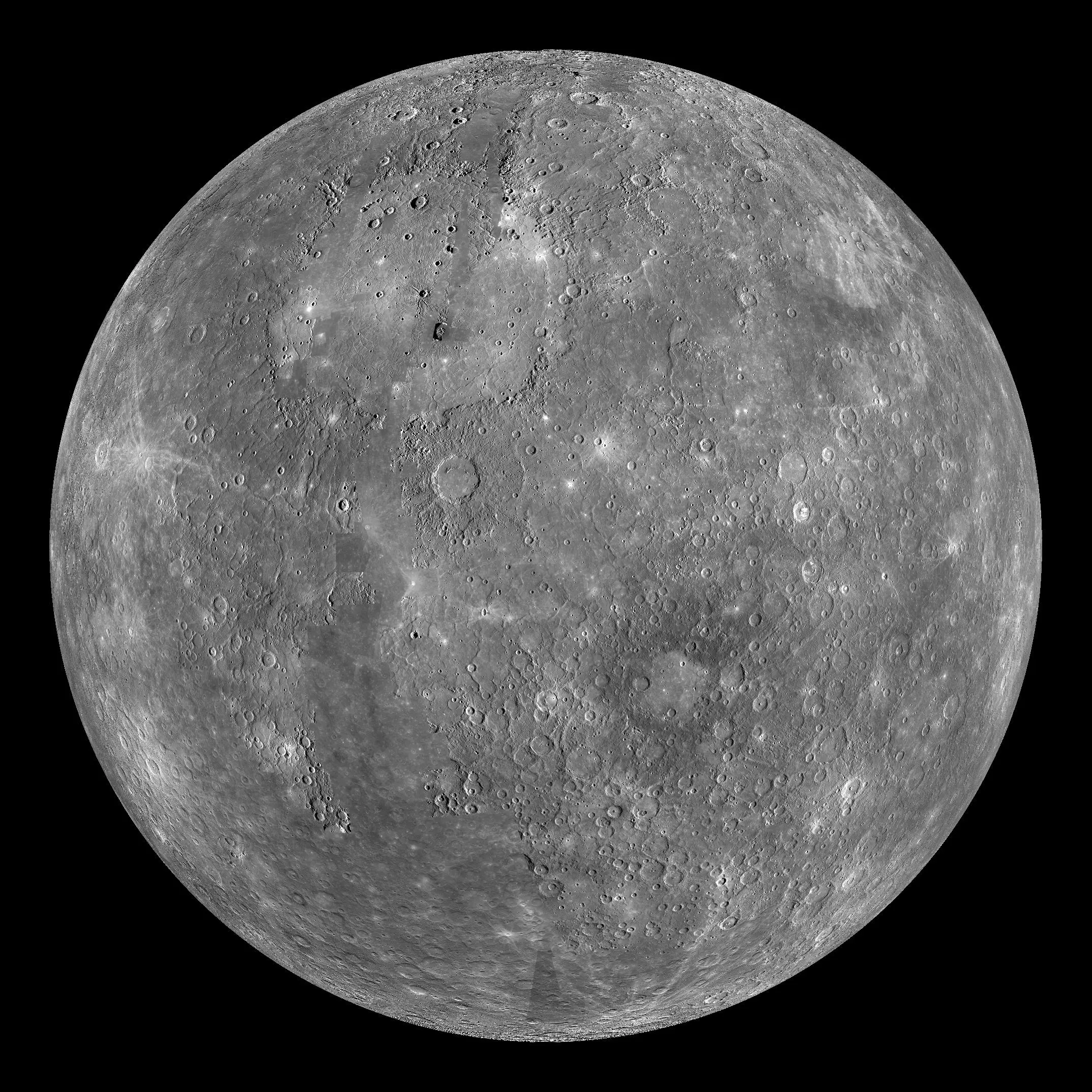
MERCURY!! One of my favs! so cute!!
Despite its small size, Mercury is actually very interesting!
Its the closest planet to the sun! I wonder how it can endure all that heat 0_0

Mercury is the first planet from the Sun and the smallest in the Solar System. It is a rocky planet with a trace atmosphere and a surface gravity slightly higher than that of Mars.
The surface of Mercury is similar to Earth's Moon, being cratered, with an expansive rupes system generated from thrust faults, and bright ray systems, formed by ejecta.
While there are large areas of smooth terrain, there are also cliffs, some hundreds of miles long and soaring up to a mile high. They rose as the planet's interior cooled and contracted over the billions of years since Mercury formed.
Its largest crater, Caloris Planitia, has a diameter of 1,550 km (960 mi), which is about one-third the diameter of the planet (4,880 km or 3,030 mi).
Most of Mercury's surface would appear greyish-brown to the human eye. The bright streaks are called "crater rays." They are formed when an asteroid or comet strikes the surface. The tremendous amount of energy that is released in such an impact digs a big hole in the ground, and also crushes a huge amount of rock under the point of impact. Some of this crushed material is thrown far from the crater and then falls to the surface, forming the rays. Fine particles of crushed rock are more reflective than large pieces, so the rays look brighter. The space environment – dust impacts and solar-wind particles – causes the rays to darken with time.
Being the most inferior orbiting planet, it always appears close to the Sun in Earth's sky, either as a "morning star" or an "evening star".
It is the planet with the highest delta-v required for travel from Earth, as well as to and from the other planets in the Solar System.
Mercury's sidereal year (88.0 Earth days) and sidereal day (58.65 Earth days) are in a 3:2 ratio, in a spin–orbit resonance. Consequently, one solar day (sunrise to sunrise) on Mercury lasts for around 176 Earth days: twice the planet's sidereal year. This means that one side of Mercury will remain in sunlight for one Mercurian year of 88 Earth days; while during the next orbit, that side will be in darkness all the time until the next sunrise after another 88 Earth days.
Above the planet's surface is an extremely tenuous exosphere and a faint magnetic field just strong enough to deflect solar winds. Combined with its high orbital eccentricity, the planet's surface has widely varying sunlight intensity and temperature, with the equatorial regions ranging from −170 °C (−270 °F) at night to 420 °C (790 °F) during sunlight.
Mercury's magnetic field is offset relative to the planet's equator. Though Mercury's magnetic field at the surface has just 1% the strength of Earth's, it interacts with the magnetic field of the solar wind to sometimes create intense magnetic tornadoes that funnel the fast, hot solar wind plasma down to the surface of the planet. When the ions strike the surface, they knock off neutrally charged atoms and send them on a loop high into the sky.
Instead of an atmosphere, Mercury possesses a thin exosphere made up of atoms blasted off the surface by the solar wind and striking meteoroids. Mercury's exosphere is composed mostly of oxygen, sodium, hydrogen, helium, and potassium.
Despite its proximity to the Sun, Mercury is not the hottest planet in our solar system – that title belongs to nearby Venus, thanks to its dense atmosphere. But Mercury is the fastest planet, zipping around the Sun every 88 Earth days.
With a radius of 1,516 miles (2,440 kilometers), Mercury is a little more than 1/3 the width of Earth. If Earth were the size of a nickel, Mercury would be about as big as a blueberry.
From an average distance of 36 million miles (58 million kilometers), Mercury is 0.4 astronomical units away from the Sun. One astronomical unit (abbreviated as AU), is the distance from the Sun to Earth. From this distance, it takes sunlight 3.2 minutes to travel from the Sun to Mercury.
Mercury's highly eccentric, egg-shaped orbit takes the planet as close as 29 million miles (47 million kilometers) and as far as 43 million miles (70 million kilometers) from the Sun. It speeds around the Sun every 88 days, traveling through space at nearly 29 miles (47 kilometers) per second, faster than any other planet.
Mercury spins slowly on its axis and completes one rotation every 59 Earth days. But when Mercury is moving fastest in its elliptical orbit around the Sun (and it is closest to the Sun), each rotation is not accompanied by sunrise and sunset like it is on most other planets. The morning Sun appears to rise briefly, set, and rise again from some parts of the planet's surface. The same thing happens in reverse at sunset for other parts of the surface. One Mercury solar day (one full day-night cycle) equals 176 Earth days – just over two years on Mercury.
Mercury's axis of rotation is tilted just 2 degrees with respect to the plane of its orbit around the Sun. That means it spins nearly perfectly upright and so does not experience seasons as many other planets do.
Due to its very small axial tilt, the planet's poles are permanently shadowed. This strongly suggests that water ice could be present in the craters.
Like the other planets in the Solar System, Mercury formed approximately 4.5 billion years ago. There are competing hypotheses about Mercury's origins and development, some of which incorporate collision with planetesimals and rock vaporization; as of the early 2020s, many broad details of Mercury's geological history are still under investigation or pending data from space probes.
Its mantle is highly homogeneous, which suggests that Mercury had a magma ocean early in its history, like the Moon.
Mercury is the second densest planet, after Earth. It has a large metallic core with a radius of about 1,289 miles (2,074 kilometers), about 85% of the planet's radius. There is evidence that it is partly molten or liquid. Mercury's outer shell, comparable to Earth's outer shell (called the mantle and crust), is only about 400 kilometers (250 miles) thick.
Mercury does not have any rings or moons.
Mercury is a classical planet that has been observed and recognized throughout history as a planet (or wandering star). In English, it is named after the ancient Roman god Mercurius (Mercury), god of commerce and communication, and the messenger of the gods.
The first successful flyby of Mercury was conducted by Mariner 10 in 1974, and it has since been visited and explored by the MESSENGER and BepiColombo orbiters.
