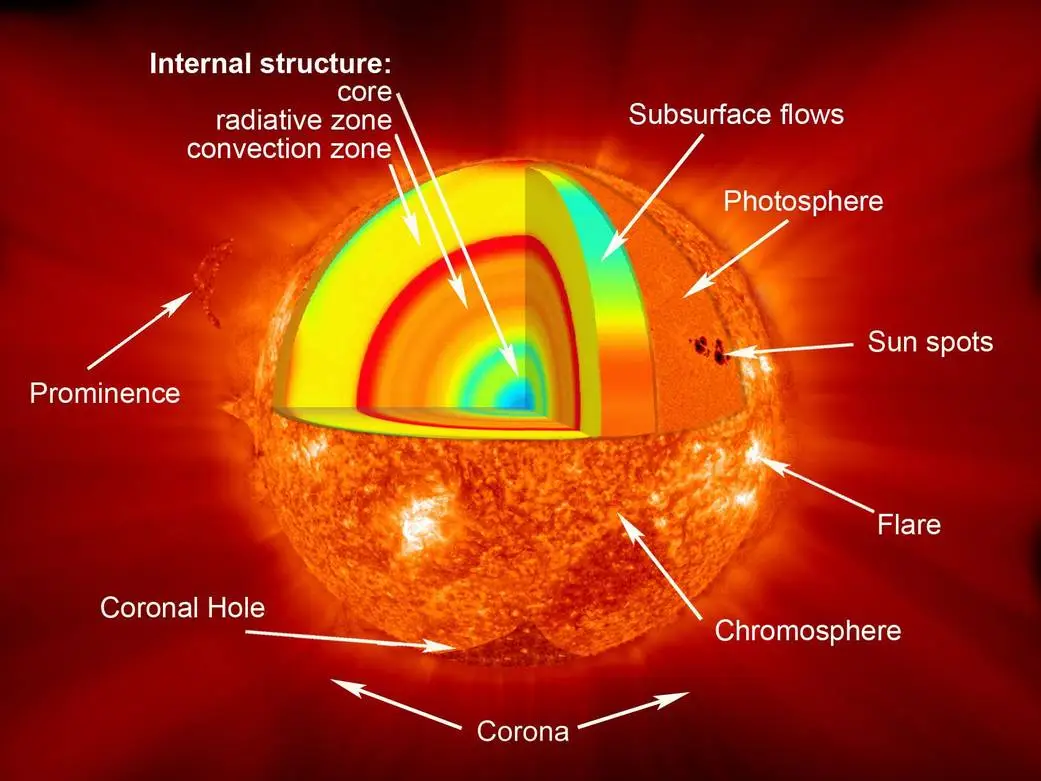
The Sun!!
Our sun is the center of our solar system, everything revolves around it!
It provides heat and light to the earth, allowing it to have life!
Im very excited to read about the sun!
I've always been interested in the sun, and Sun is one of my favorite characters in Solarballs ;]

The sun is the yellow dwarf star at the center of our solar system.
It is a ball of hot plasma, heated to incandescence (the emission of visible light from a hot body as a result of its high temperature) by nuclear fusion reactions in its core, radiating the energy from its surface as visible light and infrared radiation with 10% at ultraviolet energies.
The Sun's gravity holds the solar system together, keeping everything – from the biggest planets to the smallest particles of debris – in its orbit. The connection and interactions between the Sun and Earth drive the seasons, ocean currents, weather, climate, radiation belts and auroras.
Even though the Sun is the center of our solar system and essential to our survival, it’s only an average star in terms of its size.
Its mean distance from Earth is about 1.496×10⁸ kilometres or about 8 light-minutes. The distance between the Sun and the Earth was used to define a unit of length called the astronomical unit (au), now defined to be 149.5978707×10⁶ kilometres.
It is the largest and most massive object in the Solar System; its diameter is about 1,391,400 km (864,600 mi), around 109 times that of Earth. The Sun's mass is around 330,000 times that of Earth, making up about 99.86% of the total mass of the Solar System.
The Sun orbits the center of the Milky Way, bringing with it the planets, asteroids, comets, and other objects in our solar system. Our solar system is moving with an average velocity of 450,000 miles per hour (720,000 kilometers per hour). But even at this speed, it takes about 230 million years for the Sun to make one complete trip around the Milky Way.
The Sun rotates on its axis as it revolves around the galaxy. Its spin has a tilt of 7.25 degrees with respect to the plane of the planets’ orbits. Since the Sun is not solid, different parts rotate at different rates. At the equator, the Sun spins around once about every 25 Earth days, but at its poles, the Sun rotates once on its axis every 36 Earth days.
The mass of the Sun's surface layer, its photosphere, consists mostly of hydrogen (~73%) and helium (~25%), with much smaller quantities of heavier elements, including oxygen, carbon, neon, and iron.
The Sun formed approximately 4.6 billion years ago from the gravitational collapse of matter within a region of a large molecular cloud. Most of this matter gathered in the centre; the rest flattened into an orbiting disk that became the Solar System. The central mass became so hot and dense that it eventually initiated nuclear fusion in its core. It is now classified as a G-type main-sequence star (G2V). Every second, the Sun's core fuses about 600 billion kilograms (kg) of hydrogen into helium and converts 4 billion kilograms of matter into energy.
The hottest part of the Sun is its core, where temperatures top 27 million °F (15 million °C). The part of the Sun we call its surface – the photosphere – is a relatively cool 10,000 °F (5,500 °C). In one of the Sun’s biggest mysteries, the Sun’s outer atmosphere, the corona, gets hotter the farther it stretches from the surface. The corona reaches up to 3.5 million °F (2 million °C) – much, much hotter than the photosphere.
The Sun doesn’t have a solid surface like Earth and the other rocky planets and moons. The part of the Sun commonly called its surface is the photosphere. The word photosphere means "light sphere" – which is apt because this is the layer that emits the most visible light. It’s what we see from Earth with our eyes.
Although we call it the surface, the photosphere is actually the first layer of the solar atmosphere. It's about 250 miles thick, with temperatures reaching about 10,000 degrees Fahrenheit (5,500 degrees Celsius). That's much cooler than the blazing core, but it's still hot enough to make carbon – like diamonds and graphite – not just melt, but boil. Most of the Sun's radiation escapes outward from the photosphere into space.
Above the photosphere is the chromosphere, the transition zone, and the corona. Not all scientists refer to the transition zone as its own region – it is simply the thin layer where the chromosphere rapidly heats and becomes the corona. The photosphere, chromosphere, and corona are all part of the Sun’s atmosphere. (The corona is sometimes casually referred to as “the Sun’s atmosphere,” but it is actually the Sun’s upper atmosphere.)
The Sun’s atmosphere is where we see features such as sunspots, coronal holes, and solar flares.
The Sun would have been surrounded by a disk of gas and dust early in its history when the solar system was first forming, about 4.6 billion years ago. Some of that dust is still around today, in several dust rings that circle the Sun. They trace the orbits of planets, whose gravity tugs dust into place around the Sun.
The Sun generates magnetic fields that extend out into space to form the interplanetary magnetic field – the magnetic field that pervades our solar system. The field is carried through the solar system by the solar wind – a stream of electrically charged gas blowing outward from the Sun in all directions. The vast bubble of space dominated by the Sun’s magnetic field is called the heliosphere. Since the Sun rotates, the magnetic field spins out into a large rotating spiral, known as the Parker spiral. This spiral has a shape something like the pattern of water from a rotating garden sprinkler.
The Sun doesn't behave the same way all the time. It goes through phases of high and low activity, which make up the solar cycle. Approximately every 11 years, the Sun’s geographic poles change their magnetic polarity – that is, the north and south magnetic poles swap. During this cycle, the Sun's photosphere, chromosphere, and corona change from quiet and calm to violently active.
The height of the Sun’s activity cycle, known as solar maximum, is a time of greatly increased solar storm activity. Sunspots, eruptions called solar flares, and coronal mass ejections are common at solar maximum. The latest solar cycle – Solar Cycle 25 – started in December 2019 when solar minimum occurred, according to the Solar Cycle 25 Prediction Panel, an international group of experts co-sponsored by NASA and NOAA. Scientists now expect the Sun’s activity to ramp up toward the next predicted maximum in July 2025.
Solar activity can release huge amounts of energy and particles, some of which impact us here on Earth. Much like weather on Earth, conditions in space – known as space weather – are always changing with the Sun’s activity. "Space weather" can interfere with satellites, GPS, and radio communications. It also can cripple power grids, and corrode pipelines that carry oil and gas.
The strongest geomagnetic storm on record is the Carrington Event, named for British astronomer Richard Carrington who observed the Sept. 1, 1859, solar flare that triggered the event. Telegraph systems worldwide went haywire. Spark discharges shocked telegraph operators and set their telegraph paper on fire. Just before dawn the next day, skies all over Earth erupted in red, green, and purple auroras – the result of energy and particles from the Sun interacting with Earth’s atmosphere. Reportedly, the auroras were so brilliant that newspapers could be read as easily as in daylight. The auroras, or Northern Lights, were visible as far south as Cuba, the Bahamas, Jamaica, El Salvador, and Hawaii.
Another solar flare on March 13, 1989, caused geomagnetic storms that disrupted electric power transmission from the Hydro Québec generating station in Canada, plunging 6 million people into darkness for 9 hours. The 1989 flare also caused power surges that melted power transformers in New Jersey.
